I have been immersed in Samoan culture this week, keeping company with a Samoan indigenous man “Tee”. A Christian man with a fascinating background, deeply grounded within both cultures he has lived for substantial periods of his life, Tee has been unpacking for me the nature of family in his culture, and its many parallels to the culture of family within our Australian indigenous nations’ customs and practices. My own journey with local indigenous friends of mine, one of whom “Bee” has been present for these conversations this week, has enlivened my thinking in terms of how we as a community explore the ways of getting back to “heart and hands” expressions of family togetherness that transcend simple genetic relationships. We are, for each other, family who deserve respect, honour and a hearing – independent of where we’ve come from or when we first met our creator in a personal relationship.
Devotion to structures that promote respect, understanding, deep and selfless love, rooted in a dependency on one another for greater strength as a community – it has been a humbling experience to listen and then contemplate its intersection with my own (faith-informed) understanding of family and how God would have it be amongst his people.
Funnily enough, a quote of Friedrich Nietzsche about family sums up what Tee, Bee and I have been discussing. “In family life, love is the oil that eases friction, the cement that binds closer together, and the music that brings harmony.”
The Bible is not full of perfect families; in fact, the broader narrative is, at times, around the way God can be glorified through the redemption of pretty bad choices or poor actions by family members at different times in their lives together. Family life for Moses, Noah, Adam and Eve, Abraham, Isaac, Jacob, Saul and David – just to name a few – had its share of dysfunction to be worked through.
Tee was telling me a story of redemption that involved, and still does, his own personal efforts in the restoration and renewal of a life under serious threat within his own village community in Apia (the Samoan capital). “Kay”, his cousin, was keeping bad company, making incredibly poor choices – a young man with no sense of hope. It was the persistent love of his family (as Nietzsche describes it) – oily, binding, harmonious – over several years that now has Kay leading his younger nephews in ways that are life building and full of hope.
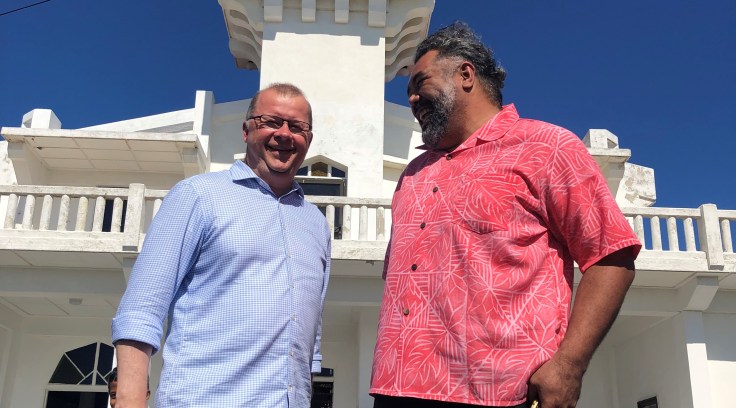 Tee’s role never changes – every time he is back in Apia, he engages in deep conversations, shares access to his business and family activities with Kay the whole time he is in country, and reminds him of the value his family, and its church, have built into Kay from his youngest days. Real, honest, deep, accountable, dealing with dysfunction with honesty and compassion – this is their small acts of obedience to God because of his love towards them.
Philippians 4:4-7 (NIV). Rejoice in the Lord always. I will say it again: Rejoice! Let your gentleness be evident to all. The Lord is near. Do not be anxious about anything, but in every situation, by prayer and petition, with thanksgiving, present your requests to God. And the peace of God, which transcends all understanding, will guard your hearts and your minds in Christ Jesus.
It’s an amazing conclusion to Paul’s letter to the church at Philippi. As I spoke with Tee and Bee this week, and reflected on God’s call on community, this passage kept coming back to me. I have been struck by how much I must learn from my brothers and sisters, in their indigenous settings – Asia, Pacific, Africa, the Americas, Middle East – in myriad locations around the world. Their capacity to express community, physically, emotionally, spiritually, is fascinating. And, in many cases, a profound example of what we miss if we seek to stay only in communion with those who are “just like us”.
I’m so thankful for conversations like the ones I’ve had this week. But I don’t want to be greedy – let me encourage you to do the same – be brave and seek to understand the way others “come to the table” with all their heritage and culture ready to be honoured and celebrated. It starts with a conversation. It’s likely to result in a journey. And it’ll be very special indeed.
 educating 4 life, too
Leave a comment