Thirty-eight years as a follower of Jesus, I wonder whether the heading of this week’s blog mightn’t be an appropriate description of the walk we embark upon after that moment of realisation we have that we need God’s grace, His complete hope, as the saving work in our life.
For me, I remember the moment – after lunch, on Sunday 6 May 1979. For others, it is a gradual realisation. Growing up in a home of believers, or not – we all have our different narratives about when and how it happened.
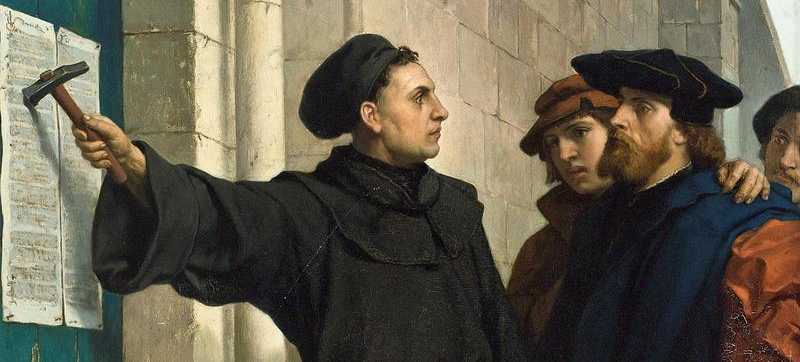
This week’s 500th anniversary of Martin Luther’s action, mailing his 95 Theses to the Archbishop of Mainz on 31 October 1517, was a historic moment marked for the effect it had on the way the gathering of God’s people, and the teaching of God’s people, was challenged; the events that followed are documented in deep and analysed detail in so many places, I would prefer not to recount them here.
Rather, let’s focus on the concepts of reformation and transformation.
Reformation is an evocative work, as much because of its link to the historic act of Luther 500 years ago. It suggests change, and often change comes with uncertainty and unexpected consequences. It is defined as “a process of change to a better state, form, etc.; improve by alteration, substitution”.
A quick Google of “List of Church Reformers” brings up a huge list; it points to the fact that many, many leaders in the church have, for centuries, had a heart felt desire to see God’s people meet together in organised ways better, in accordance with God’s plan as outlined in the Bible. A semi- to deep dive of their lives will often point to flaws in their own personal histories and behaviours. And yet – God chose to work through them to bring about social justice, better worship, clearer and more Biblical perspectives in preaching and ministries, just to name a few of their reformative outcomes.
As an ecumenical community, we would celebrate reformers from all the Christian denominations/traditions – reformed, protestant, catholic, orthodox, independent, multi-campus, charismatic, systemic, liturgical, free-form – the list goes on. With my own personal ethnic roots in Bohemia, my personal reformer hero is Jan Huss, a Moravian in ethnicity whose focus on preaching the gospel to all, wherever they might be, gave birth to a movement of churches with a focus that always interests me.
I would assert – reformation without transformation is a little like a sausage without the benefit the sizzle gives it before you eat it. That is, a raw sausage, whilst edible, is only part of the purpose – and potentially dangerous in isolation. You need to cook it, sizzle it, to get the full taste and dietary benefit.
Transformation is the second stage, the outworking of what reformation is intended to produce. I love the fact that our school embraces, willingly, many, many Christian denominations and traditions (at last count, 48 currently within our community). We focus on Christ, we focus on authentic Christian community – it’s behaviours and messages, and we focus on seeking God’s leading through deep understandings of the Biblical perspectives gifted to us by God through all our educational endeavours.
One of the really terrific CEN resources many of our staff use as a development tool for our thinking is a book called “Transformational Education”. A poem found in it, written by a 12 year old student, is a wonderful reflection on the way Colossians 1:15-20 can work itself out in a transformative way in the lives of our students:
We are God’s dish drying towels, to wipe away hate.
We are God’s glass to see the cup half full.
We are God’s microphone to preach His words.
We are God’s song to praise Him.
 educating 4 life, too
Leave a comment